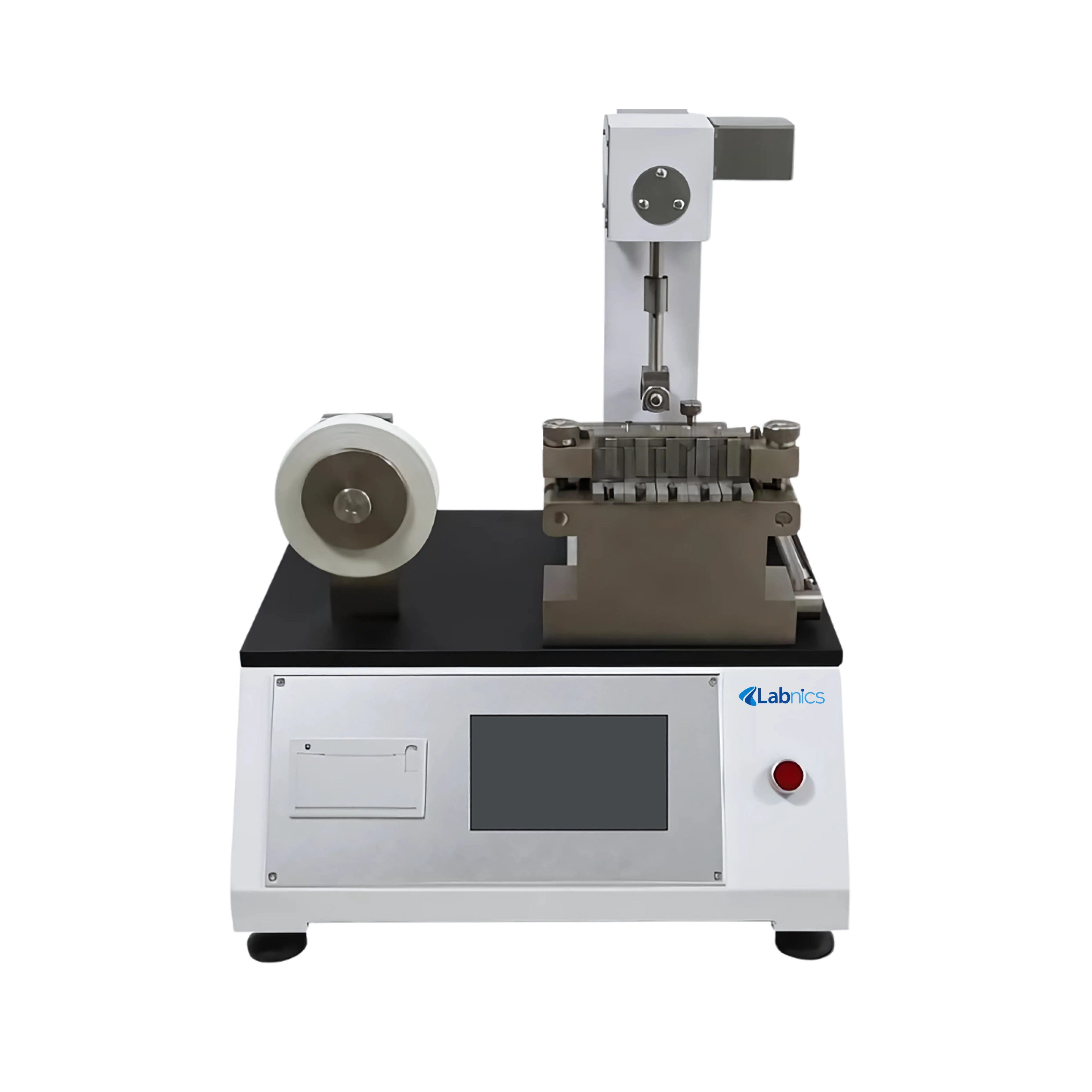
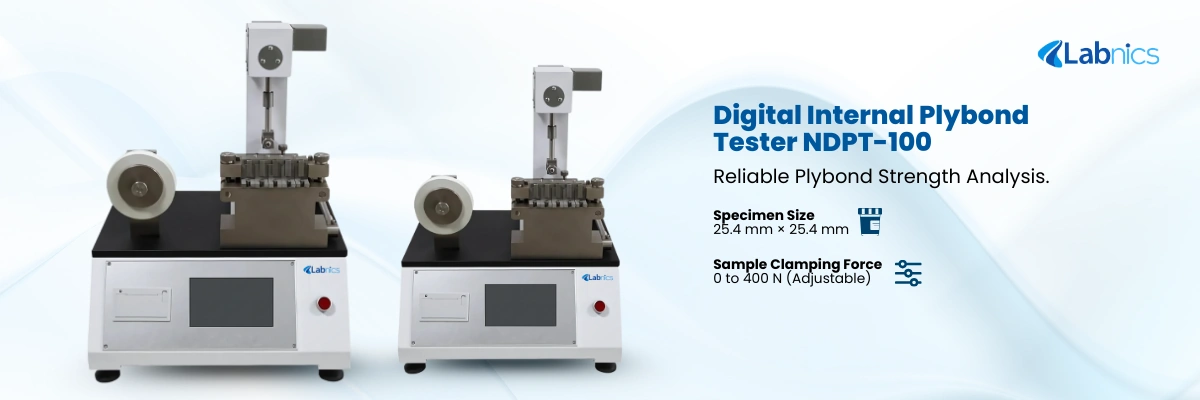
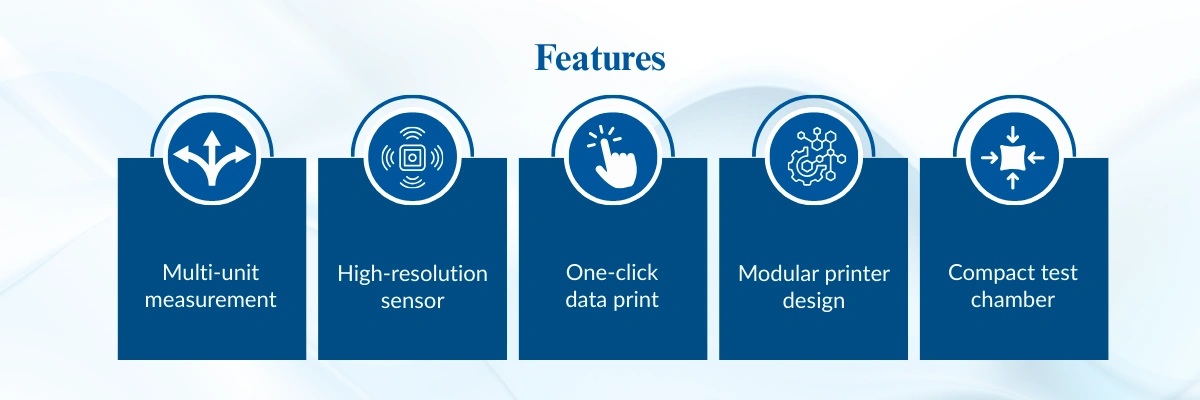
Digital Internal Plybond Tester NDPT-100 features a hydraulic glue press with adjustable pressure up to 400 N. It has an LCD and a microcomputer system that allows for real-time monitoring and automated result processing. Our unit can test up to five samples simultaneously, streamlining lab efficiency. It enables automated testing with instant data recording and efficient result processing. This modular thermal printer allows for instant result documentation with minimal maintenance.
FAQ for Digital Internal Plybond Tester NDPT-100
1: How many samples can be tested at once in the Digital Internal Plybond Tester NDPT-100?
The Digital Internal Plybond Tester NDPT-100 allows simultaneous testing of up to five paperboard samples, significantly reducing overall testing time and improving throughput in high-volume testing environments.
2: What units does the Digital Internal Plybond Tester NDPT-100 support for measurement?
Digital Internal Plybond Tester NDPT-100 supports J/m², kg/cm, and N/m, allowing you to choose the most appropriate unit depending on regional standards or internal lab preferences.
3: What makes this Digital Internal Plybond Tester NDPT-100 suitable for research labs?
Digital Internal Plybond Tester NDPT-100 has microcomputer-controlled operation, automated result processing, and high-resolution accuracy (0.001 lbf/in²) make it suitable for detailed research analysis and precise quality control.
4: Can the clamping force be adjusted manually in Digital Internal Plybond Tester NDPT-100?
Digital Internal Plybond Tester NDPT-100 has a glue pressing that is hydraulically controlled and fully adjustable, enabling customized pressure settings up to 400 N for different sample types or testing conditions.
5: Is the printer built-in and easy to maintain in the Digital Internal Plybond Tester NDPT-100?
Yes, the Digital Internal Plybond Tester NDPT-100 uses a modular type printer that is easy to install, service, or replace. This ensures reliable test result printing without extended downtime or technical assistance.
6: Why is material testing important?
Material testing is crucial for determining whether materials can withstand operational conditions, reduce the risk of failure and ensure product reliability.
7: Where are Material Testing Machines commonly used?
They are widely used in research labs, manufacturing units, automotive, aerospace, and construction industries for quality control and R&D.
8: What types of tests can a Material Testing Machine perform?
It can perform tensile, compression, hardness, fatigue, impact, and flexibility tests depending on the model and configuration.
9: How does a Material Testing Machines improve product quality?
By accurately measuring material properties, it helps manufacturers ensure compliance with standards, reduce defects, and improve durability and performance.