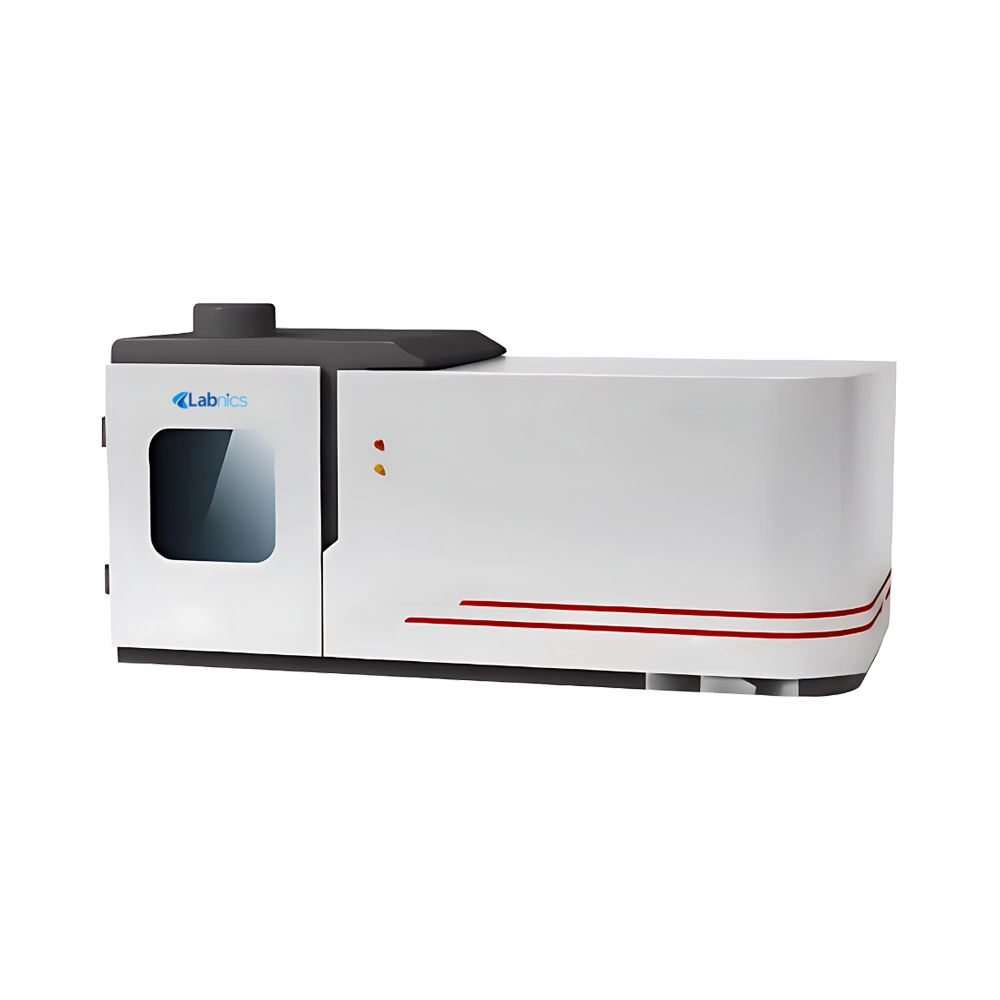
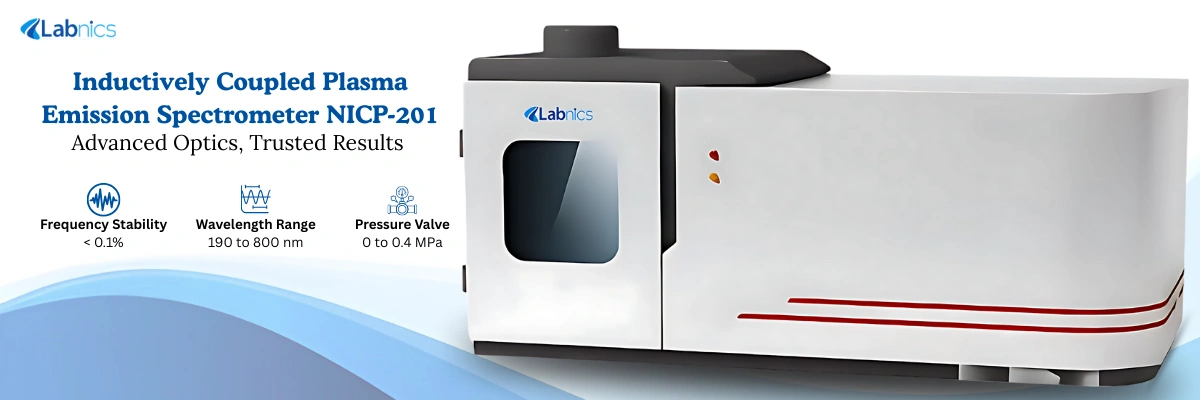
Inductively Coupled Plasma Emission Spectrometer NICP-201 comes with 0 to 0.4 MPa pressure valve and focal length of 1000 mm. It has a high optical resolution, supported by the Czerny-Turner design enhances analytical accuracy. Our coaxial nebulizer system improves sample introduction and efficiency. This precision step motor control enhances repeatability and data reliability for complex analytical workflows.
| Wavelength Range |
3600 L/mm: 190 to 500 nm; 2400 L/mm: 190 to 800 nm |
| Sampling System |
Torque tube: Three concentric, OD 20 mm |
| Torch Working Coil |
Inner diameter: 25 mm |
| Nebulizer |
Coaxial type, Outer diameter 6 mm |
| Spray Chamber |
Double barrel atomizing chamber, OD 34 mm |
| Gas Flow Control |
Plasma Argon: 100 to1000 L/h (1.6 to16 L/min)
Auxiliary Argon: 10 to 100 L/h (0.16 to 1.66 L/min),
Carrier Argon: 10 to 100 L/h (0.16 to 1.66 L/min) |
| Pressure Valve |
0 to 0.4 MPa |
| Cooling Water |
Temp: 20 to 25°C, Flow: > 5 L/min, Pressure: > 0.1 MPa |
| Optics |
Czerny Turner |
| Focal Length |
1000 mm |
| Grating |
Ion Beam Etched Holographic Grating, 3600 L/mm or 2400 L/mm |
| Reciprocal Linear Dispersion |
0.26 nm/mm |
| Resolution |
≤ 0.007 nm (3600 L/mm), ≤ 0.015 nm (2400 L/mm) |
| Step Motor Precision |
≤ 0.0006 nm |
| Slits |
Entrance: 10 μm; Exit: 12 μm |
| Detector |
Photomultiplier Tube: R293 / R928 |
| Negative HV on PMT |
0 to 1000 V |
| Stability |
< 0.05% |
| RF Power Circuit |
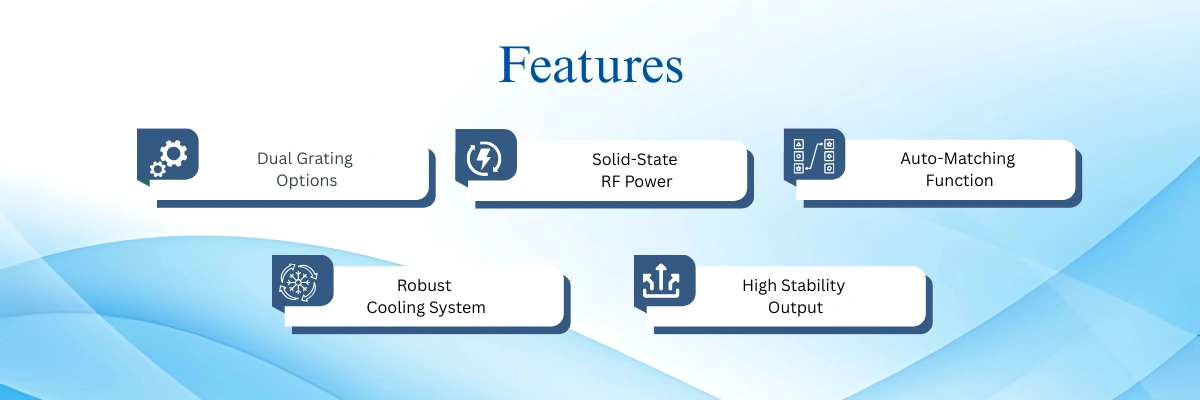
Solid-state RF power supply with auto-matching function |
| RF Frequency |
27.12 MHz ± 0.05% |
| Escaped RF Radiation |
30 cm away, Electric field E < 2 V/m |
| Frequency Stability |
< 0.1% |
| Power Output Stability |
< 0.3% |
| Power Consumption |
800 W to 1200 W |
FAQ for Inductively Coupled Plasma Emission Spectrometer NICP-201
1: How does dual grating capability enhance performance in the Inductively Coupled Plasma Emission Spectrometer NICP-201?
Dual grating in Inductively Coupled Plasma Emission Spectrometer NICP-201 offers flexibility for both high-resolution analysis and broader wavelength coverage, allowing optimized conditions for trace and major element detection in a single system.
2: What role does auto-matching play in RF power stability in the Inductively Coupled Plasma Emission Spectrometer NICP-201?
Inductively Coupled Plasma Emission Spectrometer NICP-201 has auto-matching function continuously adjusts impedance during operation, ensuring a consistent RF power supply, reducing downtime, and maintaining plasma stability for accurate readings.
3: Why is the Czerny-Turner optical system used in the Inductively Coupled Plasma Emission Spectrometer NICP-201?
Inductively Coupled Plasma Emission Spectrometer NICP-201 design minimizes optical aberrations, delivering sharp spectral lines and improved resolution, which is essential for precise quantitative and qualitative elemental analysis.
4: How does the nebulizer and spray chamber design affect accuracy in the Inductively Coupled Plasma Emission Spectrometer NICP-201?
The coaxial nebulizer in the Inductively Coupled Plasma Emission Spectrometer NICP-201 paired with a double-barrel spray chamber ensures efficient aerosol generation and consistent sample transport, leading to higher sensitivity and reproducibility.
5: Is the Inductively Coupled Plasma Emission Spectrometer NICP-201 suitable for continuous, high-throughput labs?
Yes, Inductively Coupled Plasma Emission Spectrometer NICP-201 robust RF system, automated controls, and high stability make it ideal for environments requiring large sample volumes with precise and fast elemental analysis.