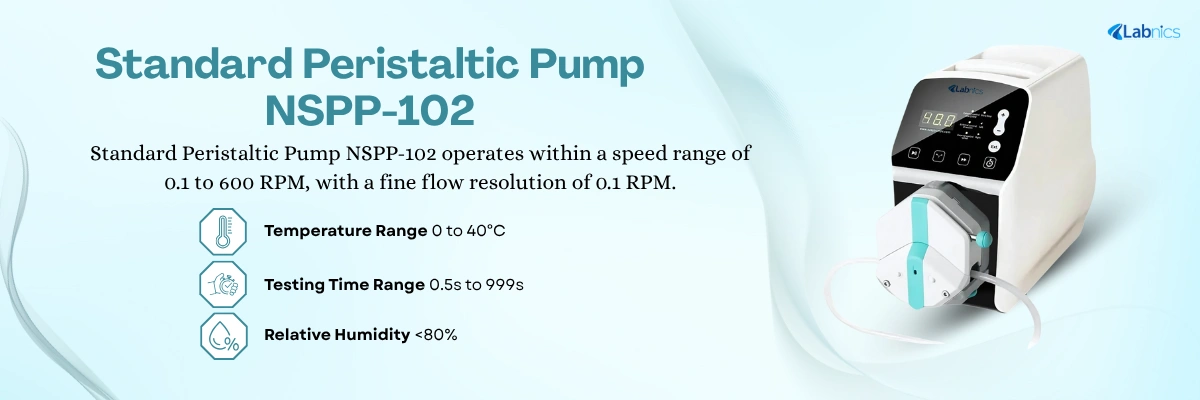
Standard Peristaltic Pump NSPP-102 operates within a speed range of 0.1 to 600 RPM, with a fine flow resolution of 0.1 RPM. It has an ABS plastic shell that enhances durability and chemical resistance. This unit includes an integrated touch pen for convenient screen navigation. It supports multiple external control modes for flexible operation. Our standard peristaltic pump features an embedded handle for comfortable and easy transport.
| Flow Range |
0.0053 to 3100 mL/min |
| Flow Resolution |
0.1 RPM |
| Speed Range |
0.1 to 600 RPM |
| Speed Resolution |
0.1 RPM (0 to 100 RPM), 1 RPM (100 to 600 RPM) |
| Testing Time Range |
0.5s to 999s |
| Motor type |
Closed-loop stepper motor |
| Temperature Range |
0 to 40°C |
| Relative Humidity |
<80% |
| Control Method |
Mechanical keyword |
| Keypad Lifespan |
300,000 times |
| External Control |
0 to 5 V, 0 to 10 V, 4 to 20 mA |
| Communication Interface |
RS232/RS485 support MODBUS protocol (RTU mode) |
| Start/Stop, Direction Signal |
Passive switch input (e.g., foot pedal) |
| Active Switch Signal |
Default 5V to 24V active input |
| Power Consumption |
<80 W |
| Power Supply |
AC 220V±10%, 50Hz/60Hz |
| Dimension |
259 × 157 × 237 mm |
| Weight |
4.40 kg |
FAQ for Standard Peristaltic Pump NSPP-102
1: Are there safety and maintenance tips for the Standard Peristaltic Pump NSPP-102?
Ensure the pump is placed on a stable surface and avoid overloading the tubing. Regular cleaning and inspection help maintain optimal performance and longevity.
2: What advantages does the ABS plastic shell with UV coating provide?
The durable ABS shell combined with UV spray coating protects the pump from corrosion and static, ensuring long-lasting performance even in demanding environments.
3: What is the function of the full speed button on the Standard Peristaltic Pump NSPP-102?
The full speed button allows the pump to quickly fill or empty fluids, which helps speed up the overall process and minimizes the need for manual handling during setup or cleaning.
4: How do RS232 and RS485 communication modes benefit the Standard Peristaltic Pump?
These communication modes enable the pump to interface with external control systems, facilitating automation and remote operation. This makes the pump well-suited for seamless integration into complex workflows.
5: What should I do if the Standard Peristaltic Pump does not start?
First, check that the power supply is connected properly and the power switch is turned on. Verify that the emergency stop or safety lock is not engaged. Inspect the fuse or circuit breaker for any faults, and ensure the tubing is correctly installed without blockages.