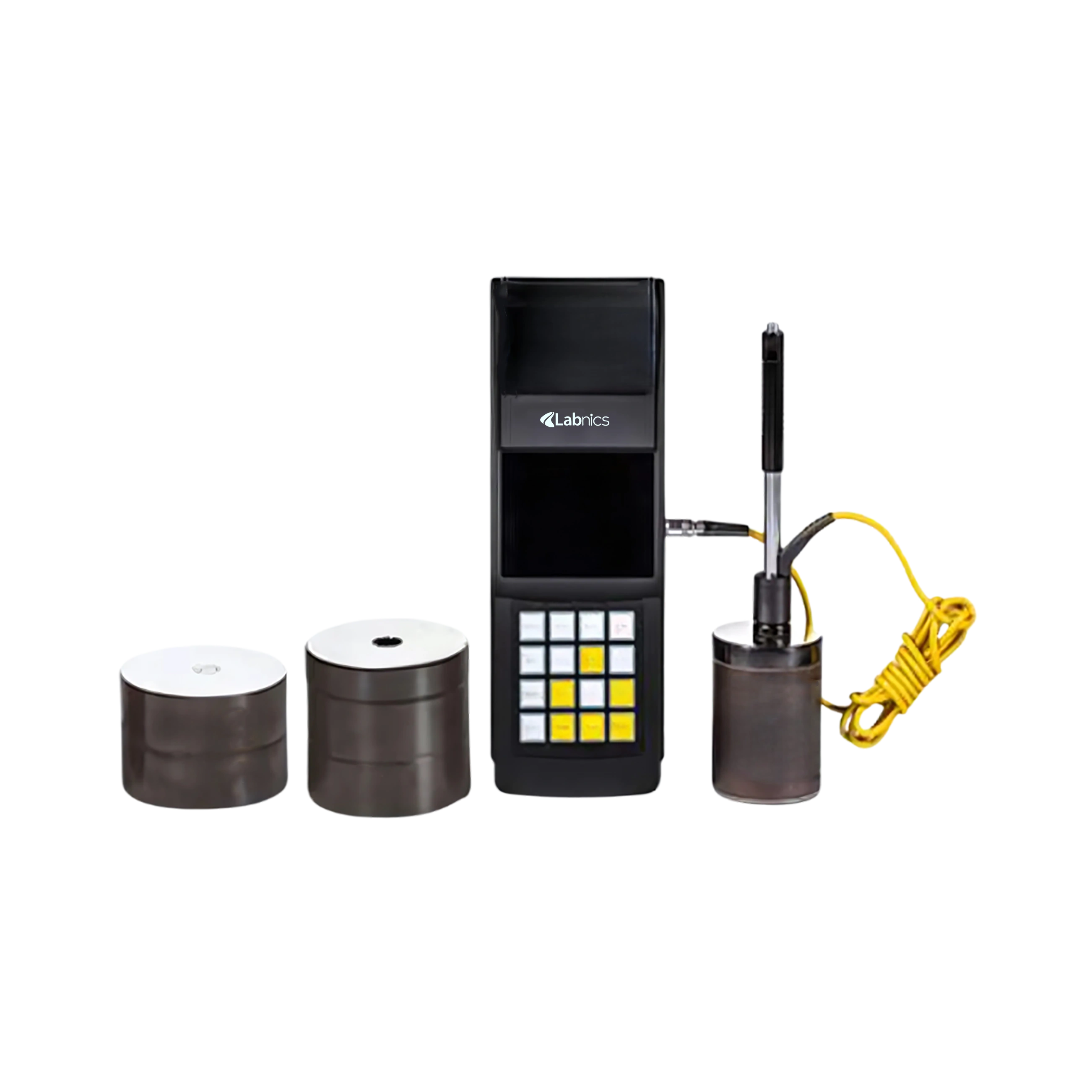
Portable Hardness Tester NPHT-101 offers a measuring range of 13 to 100 HRB for versatile testing. It supports multiple hardness scales for broad application use. This has a 360° measuring capability that provides accurate results. Our compact and lightweight design makes it easy to carry. It has fast charging and reliable performance making it suitable for industrial and field-testing needs.
FAQ for Portable Hardness Tester NPHT-101
1: What is the measuring range of the Portable Hardness Tester NPHT-101?
The Portable Hardness Tester NPHT-101 supports a broad range including 170–960 HLD, 17–68.5 HRC, 19–651 HB, 80–976 HV, 30–100 HS, 59–85 HRA, and 13–100 HRB, making it suitable for various metal hardness measurements.
2: Can the Portable Hardness Tester NPHT-101 measure hardness in any direction?
Yes, Portable Hardness Tester NPHT-101 provides 360° measurement capability, ensuring accurate results regardless of the angle or testing position, which is especially useful for irregular or fixed samples.
3: Does Portable Hardness Tester NPHT-101 include printing functionality?
Portable Hardness Tester NPHT-101 supports an integrated printer with 40 mm diameter and 44.5 ± 0.5 mm width paper, allowing users to quickly document test results on-site without extra devices.
4: How portable is the Portable Hardness Tester NPHT-101?
Portable Hardness Tester NPHT-101 has a compact dimension of 213 × 81 × 33 mm and a lightweight design of 450 g, it is highly portable, making it ideal for both lab and field applications.
5: What is the charging time and power requirement in Portable Hardness Tester NPHT-101?
The Portable Hardness Tester NPHT-101 operates on 6 V power supply and requires 2–3.5 hours charging time, offering long-lasting performance suitable for continuous industrial use.
6: What is a Portable Hardness Tester?
A Portable Hardness Tester is a compact device designed to measure the hardness of metals and alloys quickly and accurately without causing damage to the sample.
7: Where are Portable Hardness Testers used?
Portable Hardness Testers are commonly used in industries such as construction, manufacturing, research labs, and quality control departments where on-site hardness testing is required.
8: Why choose a Portable Hardness Tester over a traditional one?
Portable testers are lightweight, easy to operate, and allow quick on-site hardness evaluations, unlike traditional machines that require fixed setups and more time.
9: Are Portable Hardness Testers accurate for all metals?
Yes, Portable Hardness Testers are designed to provide accurate results across a wide range of metals and alloys, ensuring reliability in diverse applications.
10: What are the key benefits of using Portable Hardness Testers?
The main benefits of Portable Hardness Testers include portability, fast measurement, user-friendly operation, non-destructive testing, and consistent accuracy, making them highly efficient in various industries.