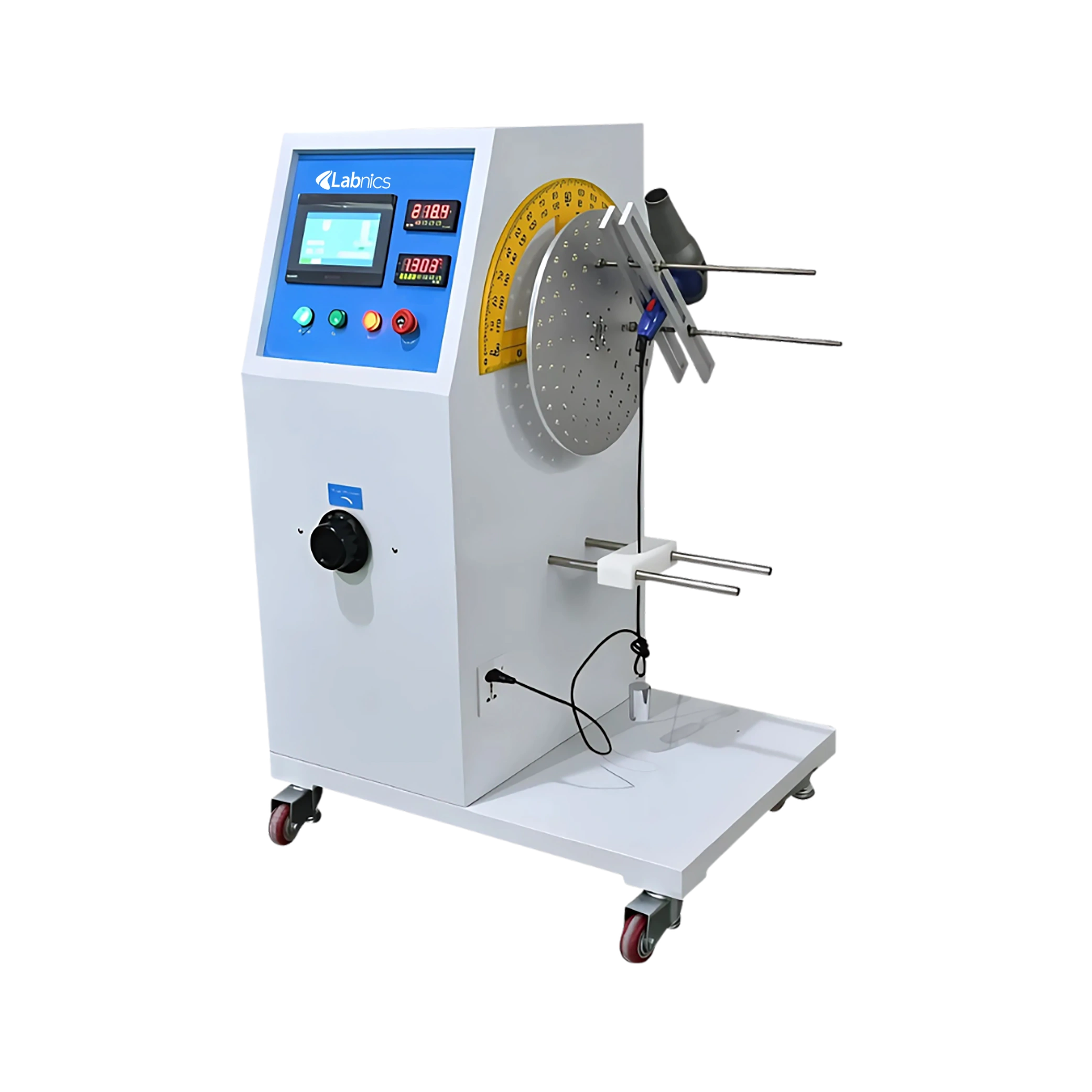
Power Cord Flexibility Tester NPFT-100 supports a flexing angle of 0–360° for accurate durability assessment. It features PLC touchscreen control for easy parameter setting and real time monitoring. Our servo motor drive ensures stable and smooth operation during extended testing. It has adjustable clamping with dual switchable clamps allows compatibility with multiple cable types. This conduction-based failure detection provides precise and reliable performance evaluation for quality assurance.
FAQ for Power Cord Flexibility Tester NPFT-100
1: What is the maximum flexing angle supported in NPFT-100?
Power Cord Flexibility Tester NPFT-100 supports a full 0–360° flexing angle, presettable on the touchscreen.
2: How many test cycles can Power Cord Flexibility Tester NPFT-100 perform?
Power Cord Flexibility Tester NPFT-100 allows up to 999999 programmable test cycles for long-duration testing.
3: Can I adjust the clamp position in Power Cord Flexibility Tester NPFT-100?
Yes, the clamping position is adjustable with switchable clamp types.
4: What drives the machine's motion?
A servo motor ensures smooth and precise flexing movements in Power Cord Flexibility Tester NPFT-100.
5: How is sample failure detected in Power Cord Flexibility Tester NPFT-100?
It detects failure by monitoring current conduction during testing.
6: Why is material testing important?
Material testing is crucial for determining whether materials can withstand operational conditions, reduce the risk of failure and ensure product reliability.
7: Where are Material Testing Machines commonly used?
They are widely used in research labs, manufacturing units, automotive, aerospace, and construction industries for quality control and R&D.
8: What types of tests can a Material Testing Machine perform?
It can perform tensile, compression, hardness, fatigue, impact, and flexibility tests depending on the model and configuration.
9: How does a Material Testing Machines improve product quality?
By accurately measuring material properties, it helps manufacturers ensure compliance with standards, reduce defects, and improve durability and performance.