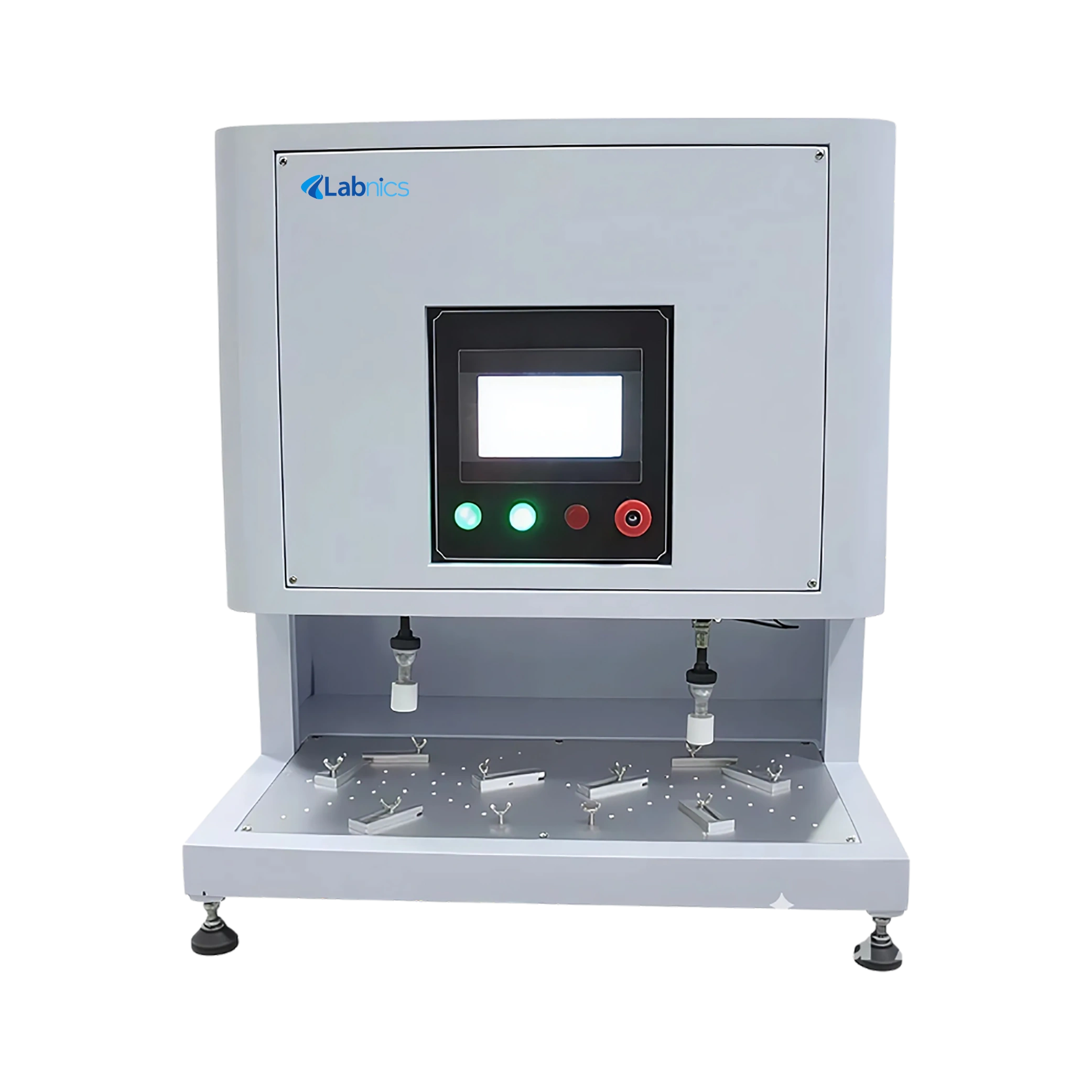
Foot Switch Fatigue Tester NFSFT-100 offers a force range up to 1500 N with 0.1 N resolution and ±1% accuracy. It features dual testing stations driven by a precision servo motor. Our touchscreen PLC control allows programmable test cycles, speed, and dwell time. This mechanical clamping system ensures secure and stable sample positioning. It has durable frame makes it ideal for long-term durability testing of foot-activated components.
FAQ for Foot Switch Fatigue Tester NFSFT-100
1: What types of foot switches can Foot Switch Fatigue Tester NFSFT-100 test?
It can test mechanical, electronic, or pneumatic foot switches across various industries including automotive, medical, and industrial equipment.
2: Can I adjust the test stroke and applied force for different switch types?
Yes, both the stroke (0–100 mm) and force (0–1500 N) are fully programmable based on the switch’s design and testing requirements.
3: Is the test process fully automated in Foot Switch Fatigue Tester NFSFT-100?
Yes, the machine uses PLC-based intelligent control and a touchscreen HMI for fully automated, repeatable testing cycles.
4: How does it ensure consistent and secure switch positioning?
Foot Switch Fatigue Tester NFSFT-100 uses a mechanical clamping system to hold switches firmly in place during testing.
5: What kind of lab environment is needed for accurate operation?
A stable environment with temperatures between 5–40?°C, humidity of 20–90% RH, and minimal vibration or electromagnetic interference is ideal.
6: Why is material testing important?
Material testing is crucial for determining whether materials can withstand operational conditions, reduce the risk of failure and ensure product reliability.
7: Where are Material Testing Machines commonly used?
They are widely used in research labs, manufacturing units, automotive, aerospace, and construction industries for quality control and R&D.
8: What types of tests can a Material Testing Machine perform?
It can perform tensile, compression, hardness, fatigue, impact, and flexibility tests depending on the model and configuration.
9: How does a Material Testing Machines improve product quality?
By accurately measuring material properties, it helps manufacturers ensure compliance with standards, reduce defects, and improve durability and performance.