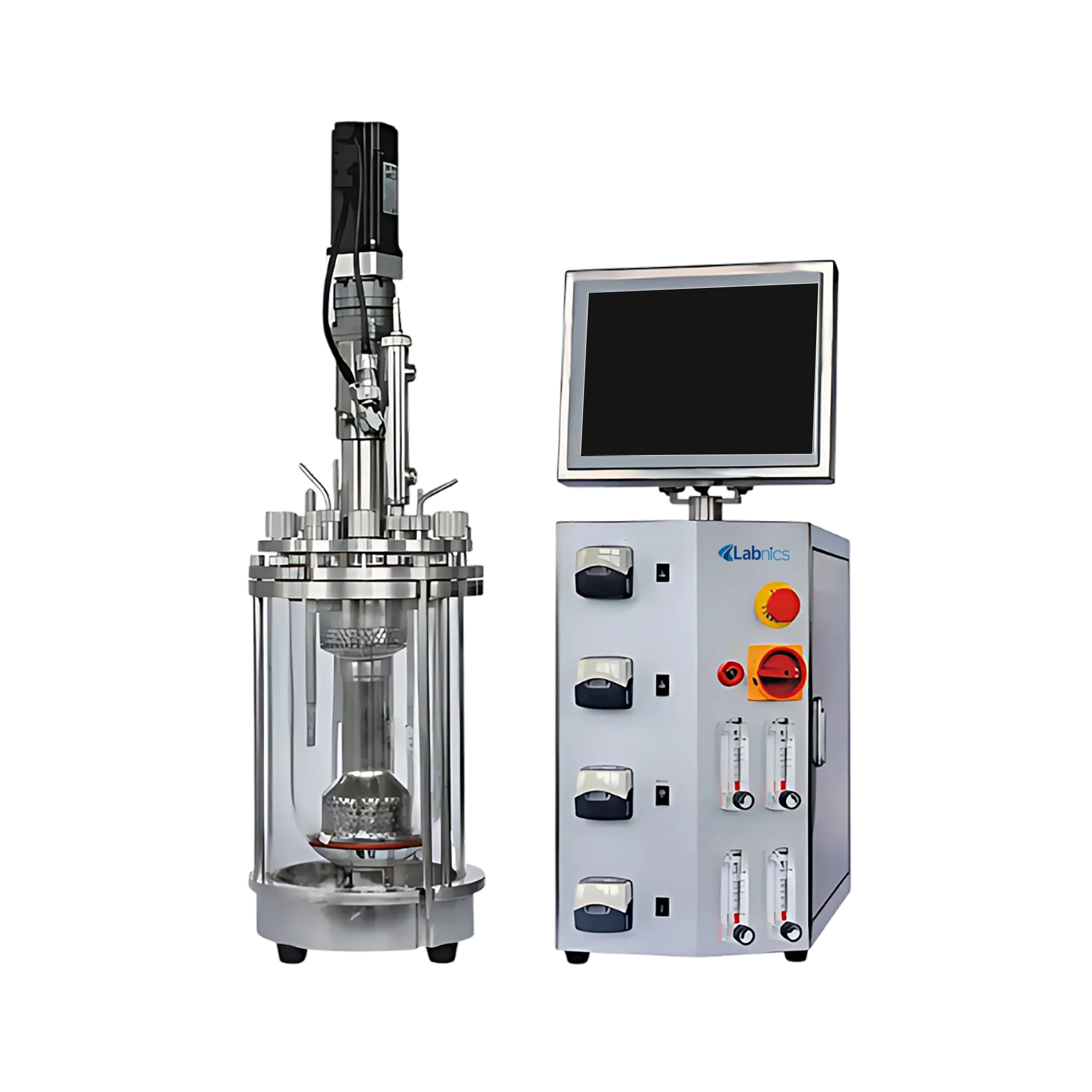
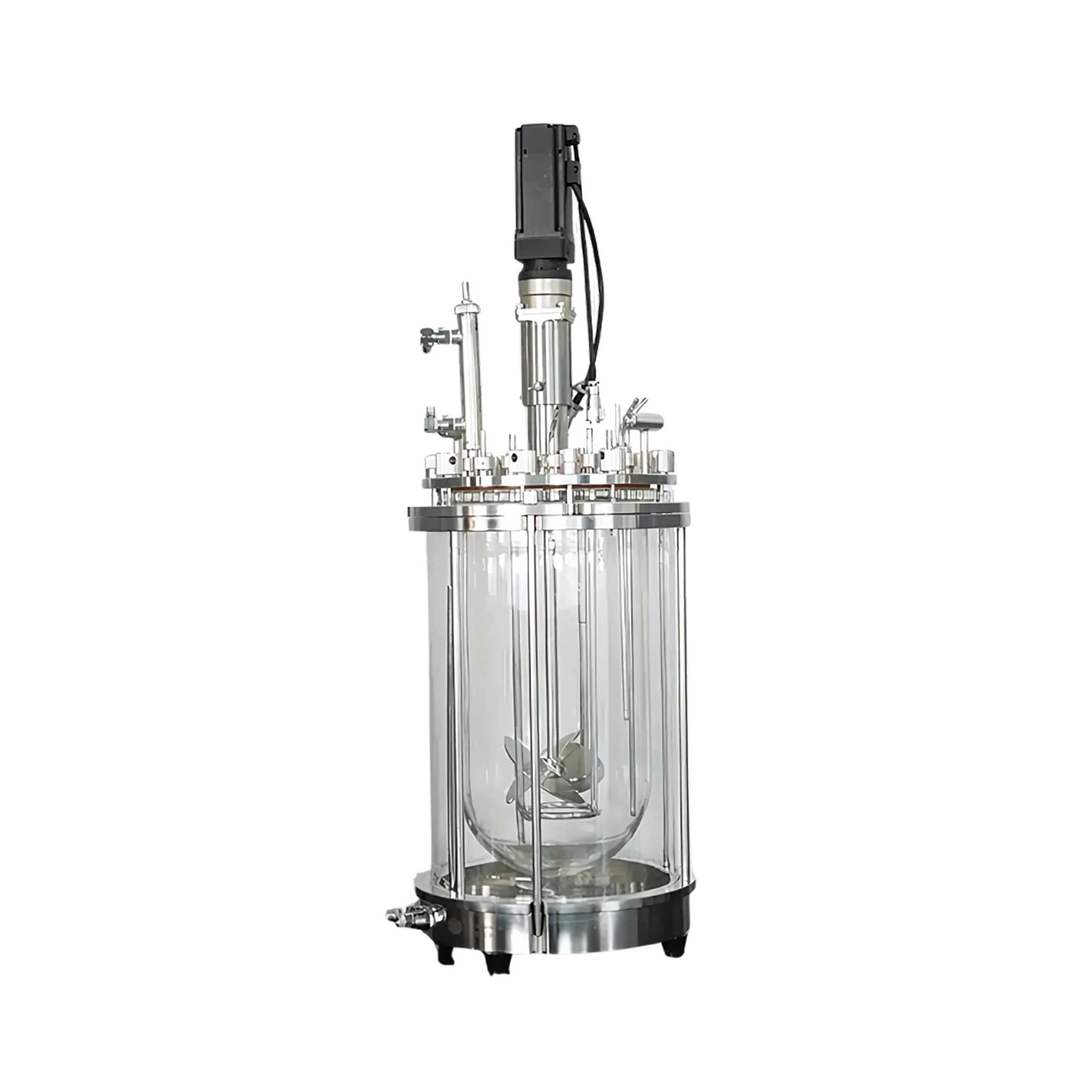
| Total Volume |
10 L |
| Working Volume |
7 L |
| Tank Material |
Borosilicate glass |
| Top Cover |
Equipped with various process ports |
| Stirring Method |
Top mixing, servo motor, PID control |
| Speed Range |
50 to 1000 rpm |
| Impeller Type |
Plow type impeller |
| pH Measurement |
Mettler or Hamilton, 0 to 14PH, PID control, accuracy: ±0.02 |
| DO Measurement |
Mettler or Hamilton, 0 to 200%, PID control, accuracy: ±2% |
| Liquid Level Sensor |
Stainless steel probe, PID control, 1 to 2 probes |
| Temperature Sensor |
Compact transmitter, accuracy: ±0.1°C |
| Gas Flow Control |
Thermal mass flow controller (0.1 to 5 SLPM) |
| Inlet Filter |
37 mm, 0.2 µm, PTFE |
| Outlet Filter |
50 mm, 0.2 µm, PTFE |
| Exhaust Condenser |
316 L stainless steel |
| Liquid Feeding |
4 peristaltic pumps, 30 rpm, 0 to 100% adjustable time |
| Temperature Control Method |
PID regulation, via cooling water or electric heating blanket |
| Temperature Control Accuracy |
Display: ±0.1°C, Control: ±0.2°C |
| Control System |
5°C to 65°C above cooling water temperature |
| Power consumption |
2 Kw, 10 A |
| Power supply |
210 to 230V, 50 to 60 Hz |
| Sterilization size (Ø × H) |
260 × 630 mm |
| Product Dimension (Ø × H) |
290 × 820 mm |
FAQ for Jacketed Glass Reactor NJGR-401
1: What types of reactions can be carried out in Jacketed Glass Reactor NJGR-401?
Jacketed Glass Reactor NJGR-401 is ideal for synthesis, crystallization, distillation, polymerization, and chemical reactions.
2: Can it be used for scale-up processes?
Yes, Jacketed Glass Reactor NJGR-401 is often used as a transition reactor between lab and industrial-scale synthesis.
3: How often should Jacketed Glass Reactor NJGR-401 be cleaned?
Clean after every use to prevent cross-contamination and maintain optimal performance.
4: Does Jacketed Glass Reactor NJGR-401 support digital control?
Yes, Labnics Jacketed Glass Reactor NJGR-401 includes a digital display for temperature, stirring speed, and time settings.
5: Is the glass explosion-proof?
The borosilicate glass is chemically and thermally resistant but should not be used beyond its rated pressure.
6: How does temperature regulation work in this Jacketed Glass Reactor?
Temperature control is achieved by circulating heating or cooling fluids through the jacket surrounding the reactor vessel. This allows for consistent and even heating or cooling during reactions, which is essential for sensitive chemical processes. The system helps prevent overheating or undercooling, improving reaction reliability.
7: Is cleaning the Jacketed Glass Reactor simple?
The smooth borosilicate glass surface makes cleaning easy and prevents chemical residues from sticking. Its corrosion resistance means fewer worries about damage during maintenance. Regular cleaning helps maintain optimal performance and safety.
8: How safe is the Jacketed Glass Reactor for daily use?
Constructed from tempered borosilicate glass, the reactor is resistant to breakage and thermal shock, ensuring safety during operation. The transparent design allows continuous visual monitoring, helping detect any issues early. Overall, it is designed to offer both reliability and user safety.
9: Can the Jacketed Glass Reactor handle aggressive chemicals safely?
Yes, the borosilicate glass is highly resistant to most acids, bases, and solvents, making it suitable for handling aggressive chemicals. This chemical resistance helps prevent contamination and maintains the purity of your reactions. It ensures safe use with a wide range of substances.