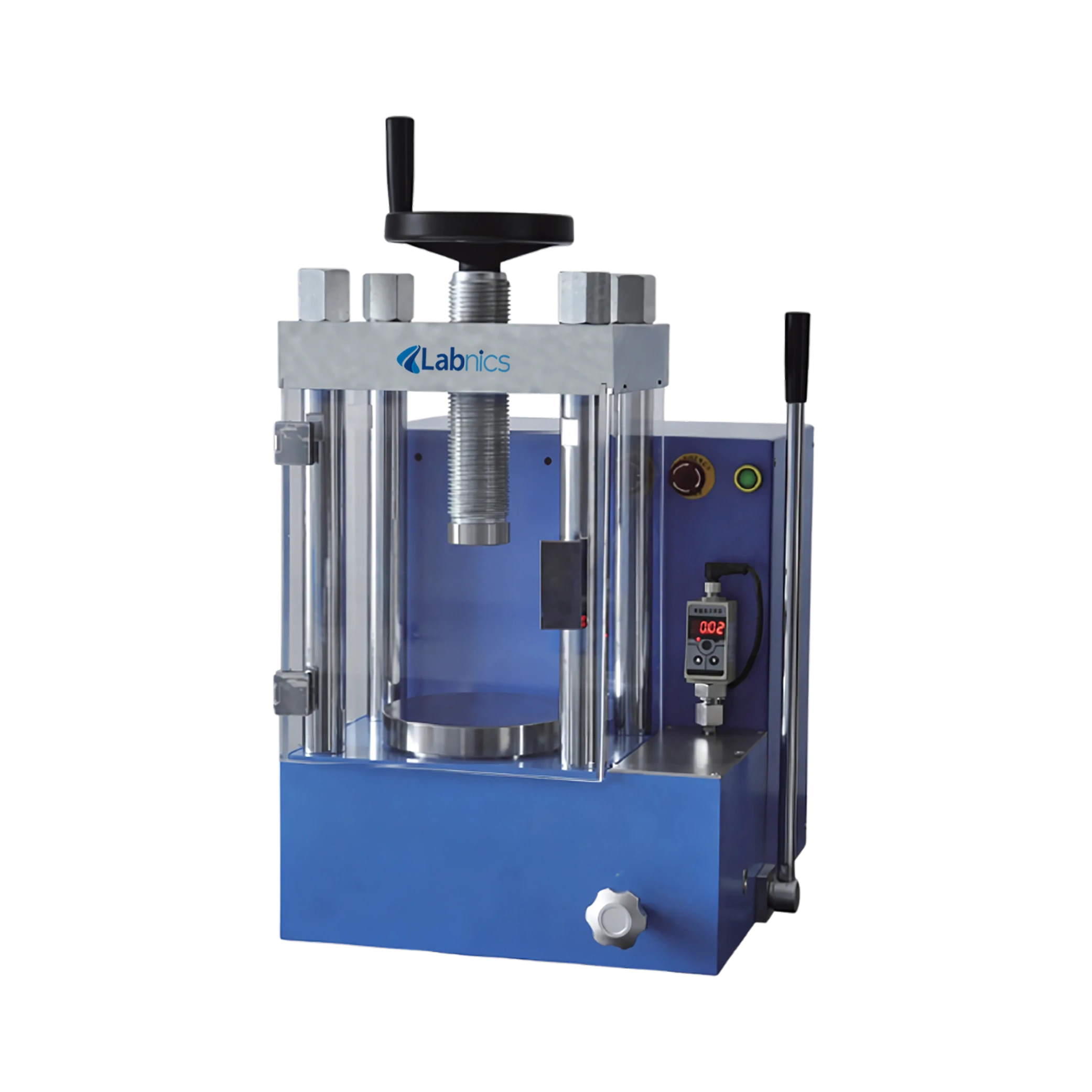
Electric Hydraulic Pellet Press NEHPP-101 is a compact electric press with a pressure range of 0–40T. It offers pressure stability of ≤1 MPa over 10 minutes for reliable and uniform pressing. This system allows accurate control of pressurization pressure for reliable results. Its dual-mode design enhances ease of use for various sample preparation needs. Our model is built with accuracy to prepare high-quality pellets, material forming, and other precision tasks.
FAQ for Electric Hydraulic Pellet Press NEHPP-101
1: What are the standard die sizes supported by Electric Hydraulic Pellet Press NEHPP-101?
Electric Hydraulic Pellet Press NEHPP-101 supports common die sizes such as 13mm, 25mm, and 32mm.
2: Can the pressure be adjusted?
Yes, pressure is adjustable through a digital control system in Electric Hydraulic Pellet Press NEHPP-101.
3: Is the Electric Hydraulic Pellet Press NEHPP-101 noisy during operation?
No, Electric Hydraulic Pellet Press NEHPP-101 is designed for low-noise or noise-free operation in lab environments.
4: Can Electric Hydraulic Pellet Press NEHPP-101 be used continuously for multiple samples?
Yes, Electric Hydraulic Pellet Press NEHPP-101 supports continuous operation and is suitable for high-throughput labs.
5: What is the expected lifespan of Electric Hydraulic Pellet Press NEHPP-101?
With proper care, the machine can function reliably for 5 to 10 years or more.
6: What materials can be processed using Electric Hydraulic Pellet Press?
Electric Hydraulic Pellet Press can compress powders, metals, ceramics, polymers, and composite materials.
7: How does Electric Hydraulic Pellet Press differ from a manual hydraulic press?
Unlike manual presses, electric models automate pressure application, offering faster and consistent operation through electricity.
8: Can Electric Hydraulic Pellet Press be integrated with other lab equipment?
Yes, Electric Hydraulic Pellet Press can be used alongside XRF, FTIR, or spectroscopy systems for sample preparation.
9: How long does it take to form one pellet?
Pellet formation usually takes less than 1–2 minutes per sample.