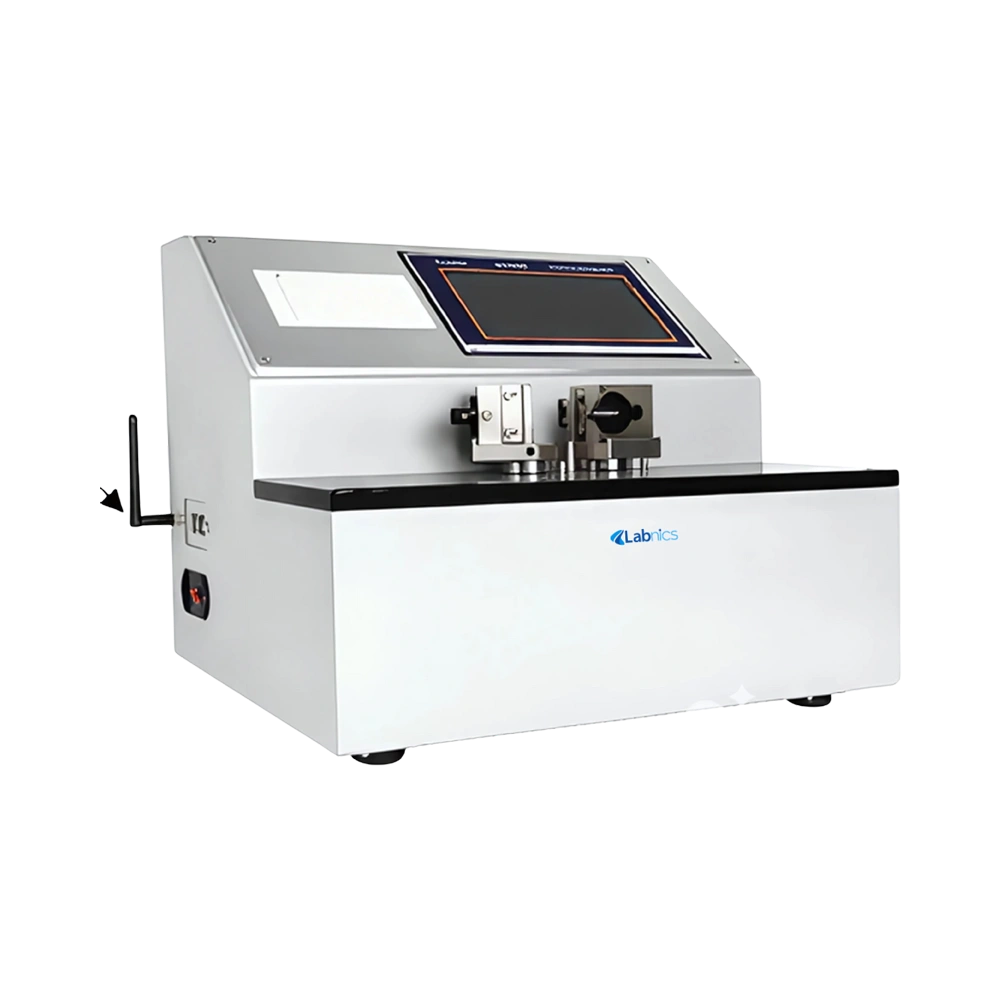
Bending Stiffness Tester NBST-100 offers a wide measurement range of 15 to 10,000mN, making it suitable for a variety of materials. It has a touchscreen interface and adjustable bending parameters that support flexible test configurations. Our built-in thermal printer enhances reporting efficiency. It has USB and WiFi interfaces to ensure easy data transfer and export. This compact unit combines precision with user-friendly operation for seamless integration into QC environments.
FAQ for Bending Stiffness Tester NBST-100
1: What is the resolution and accuracy of the Bending Stiffness Tester NBST-100?
The Bending Stiffness Tester NBST-100 features a resolution of 0.1 mN and provides high-accuracy readings with ±0.6 mN error for loads below 50 mN, making it ideal for precise stiffness evaluations across different materials.
2: Can the Bending Stiffness Tester NBST-100 store and print test data?
Yes, the Bending Stiffness Tester NBST-100 can store up to 50 records per mode and includes a built-in thermal printer for immediate documentation, making it efficient for lab workflows and audit trails.
3: Is the Bending Stiffness Tester NBST-100 suitable for both cardboard and crease testing?
Absolutely. Bending Stiffness Tester NBST-100 supports adjustable bending angles for cardboard (7.5°–50°) and a fixed 90° crease test angle, making it versatile for both stiffness and fold resistance analysis.
4: What connectivity options are available for data export in the Bending Stiffness Tester NBST-100?
The Bending Stiffness Tester NBST-100 supports USB and WiFi (2.4 GHz) connectivity, and data can be exported via U-disk, enabling easy integration into lab systems and external backups.
5: How is the Bending Stiffness Tester NBST-100 operated and monitored?
Bending Stiffness Tester NBST-100 has a 7-inch IPS HD capacitive touchscreen that provides a modern, intuitive interface, offering real-time feedback, test configuration, and graphical display for operational convenience.
6: What is a bending stiffness tester used for?
A bending stiffness tester measures how resistant a material is to bending under applied force. It helps determine flexibility and strength in materials like paper, plastic, and thin boards, ensuring they meet industry-specific durability standards.
7: What types of industries use bending stiffness testers?
Bending Stiffness Testers are widely used in industries such as packaging, printing, electronics, and textiles. They are particularly useful in quality control labs, research and development centers, and manufacturing units where material flexibility is critical.
8: How is test data recorded and retrieved?
Most modern testers offer built-in thermal printers for immediate documentation and USB or WiFi export options for digital storage. This allows users to store, share, or analyze data on external systems for auditing or compliance.
9: Can bending angle and speed be customized?
Yes, bending angle and speed can usually be adjusted to suit different testing standards. Many models allow for precise control from 1° to 90° and speed ranges from 1°/s to 100°/s, offering flexibility in test procedures.